
Increase/Decrease Chance Of Pregnancy:
Biology is a funny thing. For half of our lives, we spend an enormous amount of energy trying not to get pregnant. Then, the switch flips, and we suddenly realize that getting pregnant isn’t always as easy as the high school health teacher with the scary charts made it sound.
Whether you are actively trying to conceive (TTC) or are terrified of a missed period, the mechanics are exactly the same. The engine is the same; you just drive the car differently depending on your destination.
Understanding how to increase / decrease chances of pregnancy isn’t about luck or old wives’ tales (no, holding your legs in the air for 20 minutes probably won’t make or break the deal). It is about understanding the Fertile Window.
This guide strips away the myths and gives you the raw data and tactical advice you need to take control of your reproductive health.
The Honest Guide to Relationship Advice for Men: 10 Actually Works Advices
The Core Mechanic: The “Fertile Window”
Before we look at increasing or decreasing odds, we have to look at the playing field.
Here is the cold, hard math:
- The Egg: Once released (ovulation), an egg lives for 12 to 24 hours. That’s it. If it doesn’t meet sperm in that window, it disintegrates.
- The Sperm: These swimmers are resilient. In the right environment (fertile cervical mucus), sperm can survive inside the female body for up to 5 days.
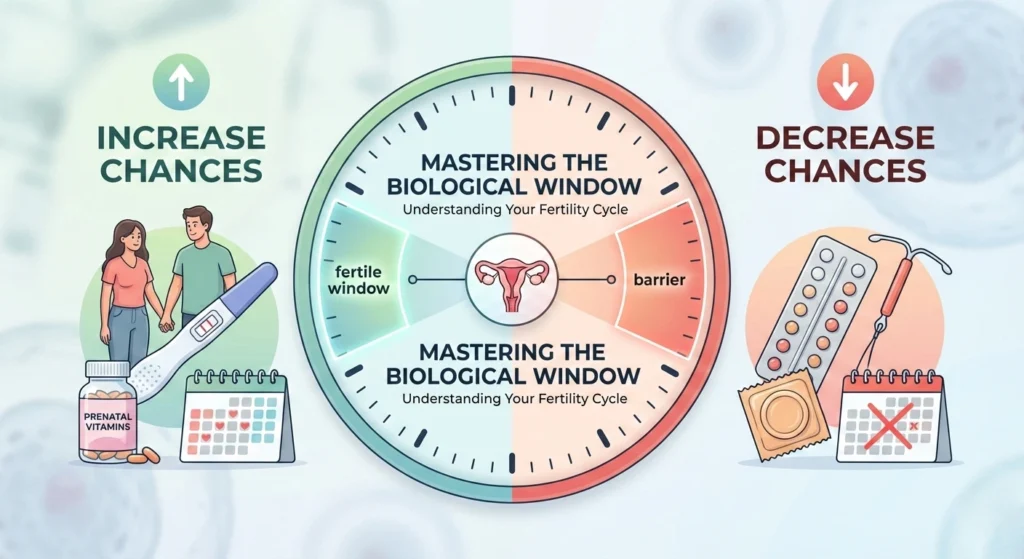
The Conclusion: You are only fertile for about 6 days per cycle (the 5 days leading up to ovulation and the day of ovulation itself).
- To Increase Chances: You want sperm waiting in the fallopian tubes before the egg drops.
- To Decrease Chances: You must ensure zero sperm is present during this window.
For a clinical breakdown of the ovulation cycle, check the American College of Obstetricians and Gynecologists (ACOG).
Part 1: How to Increase Chances of Pregnancy (The “Green Light” Protocol)
So, you are ready to start a family. You might think the strategy is just “have more sex,” and while that’s a good start, strategic timing beats blind effort every time.
1. Stop Guessing, Start Tracking
If you are relying on an app that just guesses your ovulation based on a generic 28-day calendar, you are likely missing your window. Every body is different.
- Ovulation Predictor Kits (OPKs): These pee-on-a-stick tests detect the LH surge that happens 24–36 hours before you ovulate. When that stick turns positive, it’s go-time.
- Basal Body Temperature (BBT): Your resting body temperature spikes slightly after ovulation. This confirms you ovulated, but it’s retrospective (tells you what happened yesterday).
2. The “Sperm Meets Egg” Plan
Don’t save it all up for the exact day of ovulation. Ejaculating frequently ensures fresh, healthy sperm. The Strategy: Have sex every other day starting 5 days before you expect to ovulate. This ensures a constant supply of fresh sperm in the reproductive tract without burning out your partner.
3. Check Your Lubricant
This is a silent fertility killer. Most standard lubricants (and even saliva) are not pH-balanced for sperm and can actually inhibit their movement or kill them.
- The Fix: If you need lubrication, look specifically for “fertility-friendly” lubricants (like Pre-Seed) that mimic natural cervical mucus.
4. The Lifestyle Audit
- For Her: Start taking a prenatal vitamin with 400 mcg of folic acid now. It prevents birth defects that happen in the first few weeks of pregnancy—often before you even know you’re pregnant.
- For Him: Sperm health is heavily influenced by heat and lifestyle. Tight underwear, saunas, and hot tubs can cook sperm. Keep it cool.
Expert Note: Smoking is a massive fertility blocker for both sexes. It ages ovaries and damages sperm DNA. Quitting is the single most effective lifestyle change you can make.
Read more on pre-pregnancy planning at the Centers for Disease Control and Prevention (CDC).
🔍 How to Track Ovulation:
| Method | Description |
|---|---|
| 📅 Calendar method | Track periods for a few months to predict ovulation (day 12–16 of cycle). |
| 🌡️ Basal Body Temp (BBT) | Slight rise (0.5–1°F) after ovulation. Track daily with a thermometer. |
| 💧 Cervical Mucus Check | Fertile mucus is clear, stretchy (like egg whites) — means ovulation soon. |
| 🧪 Ovulation Predictor Kits (OPKs) | Test urine for LH surge, which peaks ~24 hours before ovulation. |
| 📱 Fertility apps | Apps like Flo, Clue, or Natural Cycles help track and predict ovulation. |
Part 2: How to Decrease Chances of Pregnancy (The “Red Light” Protocol)
If you are reading this section, your goal is prevention. You want to enjoy the intimacy without the anxiety of a “late” calendar notification.
1. Barrier Methods & Hormones (The Gold Standard)
We won’t bore you with a lecture on condoms, but we will say this: Human error is the enemy.
- The Pill/Patch/Ring: 91–99% effective, but only if you are consistent. Missing a pill by a few hours (depending on the type) can trigger ovulation.
- IUDs/Implants: These are “set it and forget it.” They remove human error entirely and are over 99% effective.
2. The “Pull Out” Method Myth
Let’s be real—people do it. But you need to know why it fails. It isn’t just about self-control. Pre-ejaculate (precum) can contain motile sperm, especially if the man has ejaculated recently and hasn’t urinated since. If you are using withdrawal during the “Fertile Window” (see above), you are playing Russian Roulette with your reproductive future.
3. Fertility Awareness (FAM) as Contraception
You can use the tracking methods mentioned in Part 1 to avoid pregnancy. This involves tracking temperature and cervical mucus to identify the fertile window and abstaining (or using condoms) during those days.
- The Risk: It requires perfect diligence. Stress, illness, or travel can shift ovulation, catching you off guard. It is not recommended if a pregnancy would be disastrous for you right now.
4. Emergency Contraception (Plan B)
If the condom broke or you got swept up in the moment, act fast.
- Levonorgestrel (Plan B): Works by delaying ovulation. If you have already ovulated, it will not work. This is why taking it as soon as possible (within 72 hours) is critical.
- Copper IUD: Can be inserted by a doctor up to 5 days after unprotected sex and is nearly 100% effective as emergency contraception.
Compare effectiveness rates at Planned Parenthood’s Official Guide.
The X-Factors: Weight, Stress, and Age
Whether you want to hit the target or miss it, your general health sets the baseline.
Weight and Hormones
Body fat produces estrogen.
- Too little body fat: You might stop ovulating entirely (making pregnancy impossible).
- Too much body fat: Excess estrogen can interfere with ovulation, leading to irregular cycles which makes tracking (for either goal) a nightmare.
The Stress Connection
Cortisol (the stress hormone) competes with progesterone. If you are chronically stressed, your body may deprioritize reproduction. This can delay ovulation, making your cycle longer and your “safe days” harder to predict.
The Age Curve
We can’t ignore the biological clock.
- Peak Fertility: Late teens to late 20s.
- The Decline: Starts slowly at 30, speeds up at 35, and drops rapidly after 40. If you are over 35 and have been trying to increase chances for 6 months with no luck, it is time to see a specialist. If you are over 40 and trying to decrease chances, do not assume you are infertile—”menopause babies” happen frequently because women stop using contraception too early.
When to See a Doctor
If you are trying to increase chances:
- Under 35: Try for 1 year before seeking help.
- Over 35: Try for 6 months.
- Irregular periods: See a doctor immediately; you may not be ovulating.
If you are trying to decrease chances:
- If you have a condom mishap, seek emergency contraception immediately.
- If you want a permanent solution, discuss vasectomy or tubal ligation.
Final Thoughts
Mastering your fertility is the ultimate power move. It allows you to design your life on your own terms. Whether you are tracking temperatures to catch an egg or setting an alarm for your pill to block one, the key is consistency and knowledge.
Don’t leave your future up to a coin flip. Learn the window, choose your protocol, and act with confidence.
Related Reading on Seduce.pro:
(Disclaimer: This content is for informational purposes only and does not constitute medical advice. Always consult with a healthcare professional regarding your reproductive health.)